Command Centre / Press Room / Energy
EnergyThursday, 13 August 2026 · 6 min read
UGANDA’S MULTI-BILLION-DOLLAR OIL INVESTMENT HAS PAID OFF
By Josepha Jabo
Uganda is on the brink of First Oil. As Uganda’s oil comes into production, petroleum disputes will arise that will inevitably come before courts of law. Therefore, it is imperative that these disputes are adjudicated correctly for investor confidence.
Consequently, Petroleum Authority of Uganda (PAU), Uganda National Oil Company (UNOC), Bank of Uganda (BoU) and Uganda Revenue Authority (URA) organised a pre-departure training for judicial officers at the Supreme Court on Monday, 3rd August, 2026 ahead of a week-long judicial field visit, from 3rd-7th August, to Uganda’s oil and gas operational areas. The Minister of Energy and Mineral Development, Hon. Dr. Monica Musenero, the Chief Justice, Honorable Justice Dr. Flavian Zeija, the Governor of the Bank of Uganda, Dr. Michael Atingi-Ego, the Commissioner General of URA, Mr. John Musinguzi, the Chairperson of the JTI Governing Council, Hon. Justice Michael Chibita, the Chief Legal Officer UNOC, Mr. Peter Muliisa as well as Uganda Media Centre amongst other stakeholders were in attendance.
“You cannot successfully adjudicate what you do not understand,” the Chief Justice said, highlighting the importance of the training for the Judiciary. “Investors need judicial predictability. One of the things investors look at, is how quickly you resolve disputes when they arise.”
On Tuesday, we kickstarted the field visit with a tour of the Uganda Petroleum Institute, Kigumba (UPIK) in Kiryandongo District. The Principal of UPIK, Mr. Bernard Ongodia called it, “A centre of excellence for oil and gas training and the best petroleum institute in Sub-Saharan Africa.” Ongodia believes the institute shall become a global centre of excellence, with world class training, since their instructors have gone for training in the UK, US, France and Norway.
The institute, which sits on a large campus surrounded by buildings and planted trees, has trained Ugandan and Tanzanian students, can accommodate up to 300 students and has been benchmarked by Mozambique. The local curriculum was merged with international requirements. Their instructors have been upskilled and trained with international certifications.
It has five, modern workshops that are fully equipped: instrumentation workshop, mechanical workshop, electrical workshop, petroleum operations workshop, and welding, fabrication, pipe fittings, material testing laboratory. During the orientation session, the Chief Justice announced that there will be a partnership between UPIK and the Judicial Training Institute (JTI) in the near future.
Uganda has already begun benefitting from the petroleum industry, even before First Oil. For example, everyone can appreciate the smooth ride, courtesy of the oil roads in the Albertine Graben, built by the now defunct Uganda National Roads Authority (UNRA). Kabalega International Airport was built to support the petroleum industry. Ugandans can now invest in Kabalega Industrial Park, the investment window is open via the UNOC website.
There are employment opportunities for Ugandans, through promotion of national content. Project Affected Persons (PAPs) have been compensated in cash or kind and resettled in replacement houses. In addition, Capital Gains Tax, Surface Rental Fees, Licensing and Training Fees, Sale of Petroleum Data and Royalties are all deposited into the Petroleum Fund. After appropriation and approval by the Parliament of Uganda, Shs152 billion was released from the Petroleum Fund in May 2024 to build Hoima City Stadium, which is the biggest investment from the Petroleum Fund, so far.
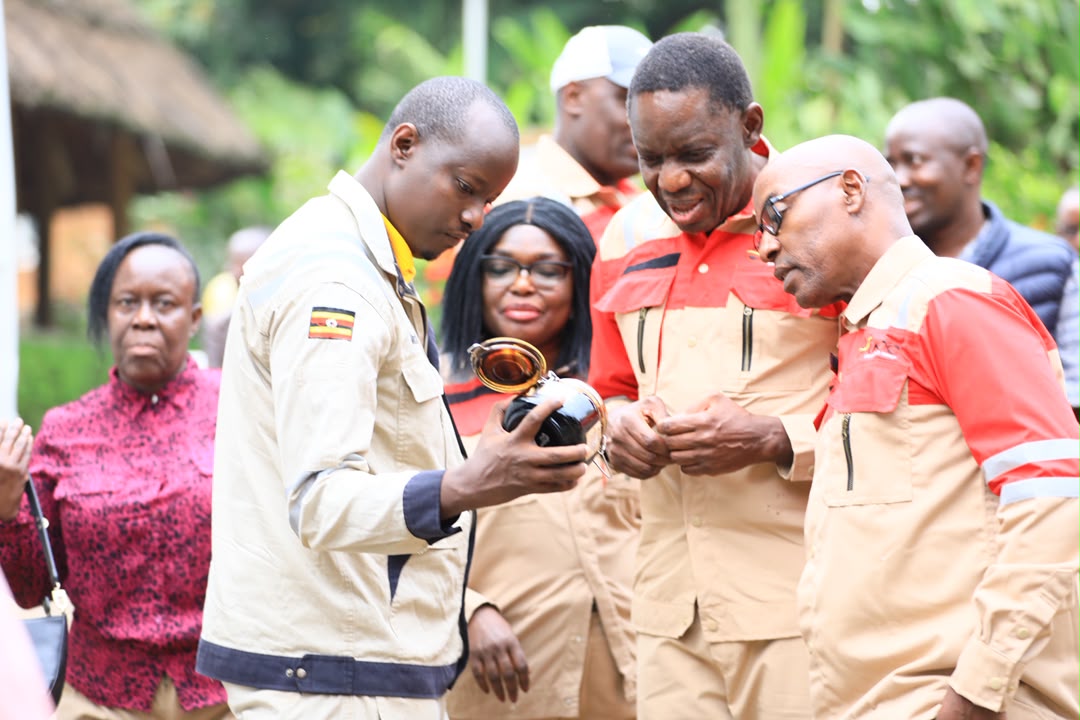
On Wednesday, the judicial officers and other government officials were decked out in their Personal Protective Equipment (PPE), beige and red jackets and trousers, white hard hats and UV protection sunglasses, to protect one’s eyes from sun glare, due to the high temperatures in the Rift Valley. At Pump Station One (PS1) we were informed that the 1,443-kilometre East African Crude Oil Pipeline (EACOP), which will be the world’s longest heated pipeline at 50ºC to transport Uganda’s waxy, crude oil is 91% complete. EACOP is a $5 billion investment.
Kingfisher Development Area, in Kikuube District, under CNOOC Uganda Limited, is a $2.5 billion investment. The Central Processing Facility (CPF) at Kingfisher is 99% complete and being commissioned, a process that involves testing the different components to confirm their full functionality following installation.
Tilenga Industrial Area, in Buliisa District, under TotalEnergies EP Uganda, is a $6 billion investment. Construction of the CPF at Tilenga was 68.6% complete by the end of July 2026. “We need to be at 80% for First Oil. Then we can go into pre-commissioning and commissioning,” the Senior Facilities Engineer at PAU, Andrew Ssennabulya, explained.
“First Oil means we have crossed from development to production. The day we have First Oil, is the day we start production. The three flagship projects Tilenga, Kingfisher and EACOP must be ready for us to announce First Oil, because they are synchronized,” the Director, Legal and Corporate Affairs PAU, Mr. Ali Ssekatawa said. First Oil can still occur before the end of this year.
“We have engaged with the licensees and agreed that we need 170 oil wells to be ready for First Oil. Out of the 170 wells, we have drilled 228 wells so far, so we have even surpassed the number of drilled wells for First Oil. We are completing the wells by inserting production tubing into the wells, which is a much quicker process,” Ssennabulya added.
Both Tilenga and Kingfisher CPFs will have crude oil separation, produce Gas-to-Power (GTP) and Liquefied Petroleum Gas (LPG). In addition, Tilenga has a 15 megawatts solar power plant. Tilenga is five times larger in size than Kingfisher. At peak production Tilenga will produce 190,000 barrels of oil per day and at peak production Kingfisher will produce 40,000 barrels of oil per day; a combined total of 230,000 barrels of oil per day.
The projects will also generate electricity. “Water, gas and sand will be separated from the crude oil and the crude will be transported to PS1. The water will be treated and sent to the wellpads for re-injection. Gas-to-Power (GTP); the gas will produce power, which will be used to operate the facilities at Tilenga.
The excess power will be transported to the national grid in Kabale. We have a cable that is already laid underground in Kabale in PS1 to Tilenga. It is a two-way cable. When we are at peak and producing a lot of gas and power, the cable will take power to the grid; when we are in decline, we will buy power from the grid, so the same cable will be used to bring power from the grid to the project. The remaining gas will be used to produce Liquefied Petroleum Gas (LPG),” the Manager Cost Monitoring at PAU, Angela Nalweyiso, disclosed.
LPG will reduce deforestation and help save Uganda’s declining forest cover, by shifting households away from reliance on firewood and charcoal for cooking.
The Refinery, which is still in design phase, will be constructed in Kabalega Industrial Park, and will come after First Oil, the Final Investment Decision (FID) is expected next year.
The Chief Justice urged the judges to be economically-minded, because legal disputes should not delay infrastructural projects and stall socioeconomic development. “Can you imagine injuncting such a project? You sit at your desk and you issue an injunction against this project from proceeding? That would be equivalent to treason,” Zeija said.
Travelling in three coaster buses, on a hot sunny Thursday, it was enchanting to see elephants, buffaloes, Rothschild giraffes and the majestic Ugandan Kob, frolicking in the savannah grass, during the game drive in Murchison Falls National Park, where the biggest oil field in the Tilenga Project, under TotalEnergies, Jobi-Rii is located. We visited Jobi-Rii 5 wellpad, where drilling was completed and the wellpad was being prepared for production with progress close to 90% completion.
“In the next three to four years, our current account balance should turn into a surplus because of oil exports,” the Governor of the Bank of Uganda, predicted during his speech that evening, at the Chief Justice’s barbecue dinner at Kabalega Resort, which marked the conclusion of the field visit. The writer works for Uganda Media Centre