Command Centre / Press Room / Technology
TechnologyThursday, 18 June 2026 · 7 min read
300 Electric Buses will be in Kampala by 2027
By Josepha Jabo
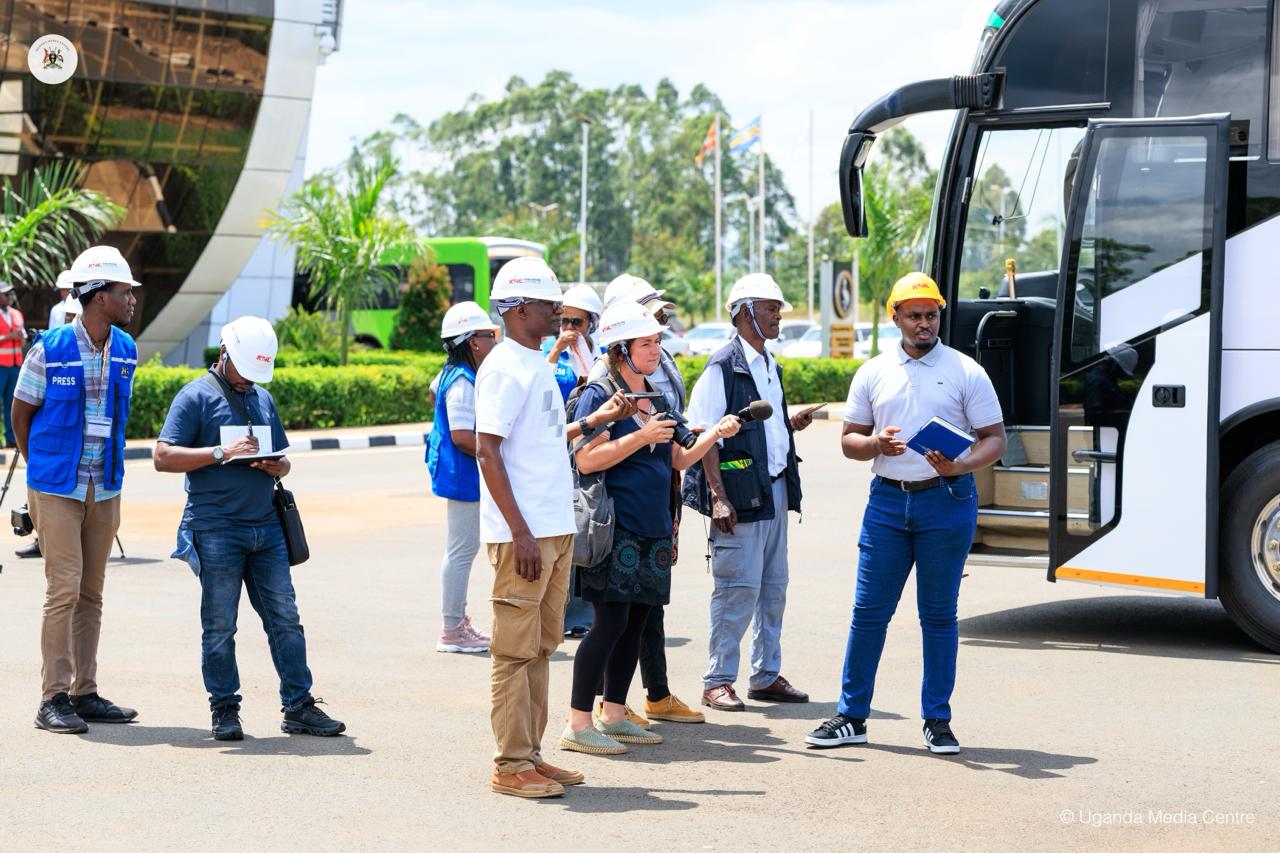
A media team, made up of local and international journalists, set off from Uganda Media Centre in Kampala on Monday, May 18, 2026 at 7am for Jinja, on a 12-metre Kayoola EVS, E-Bus Xpress; an apple green, air-conditioned, 100% electric, city bus with padded leather seats and Wi-Fi. At 10:15am we arrived Kiira Motors Corporation (KMC), a modern grey concrete and glass building, surrounded by marked walkways, a landscaped garden with trees and a waste water treatment plant. During his August 2024 state visit to KMC, King Mswati III of Eswatini planted a tree of remembrance here. KMC is the biggest electric bus plant in Africa that employs approximately 406 members of staff. It is realising the African dream because their buses are ‘Made in Uganda.’ Contrary to popular belief, some of the vehicle parts are actually made in Uganda; 21% are local products (KMC imports 79% of the vehicle parts and materials from China) and they expect 65% localisation by 2030. It was a bright sunny day, perfect weather for a tour of the Kiira Vehicle Plant. We disembarked from the bus. When we entered through the glass doors, we found the apple green Kiira EV electric vehicle prototype parked to the left of the reception area. We were welcomed in the reception by Lateefa, an engineer, who gave us white KMC hard hats to wear, as part of our personal protective equipment against the moving equipment and specialised machinery we were about to encounter. Shaban Senyange, the Corporate Affairs Manager and Vincent Muhumuza, the Senior Quality Inspection and Testing Engineer, introduced themselves to our team. Once again, we boarded the bus, where a safety induction video played in the background, while Muhumuza, who was standing in the bus aisle, delivered his sales pitch. “KMC is the most competent, the largest, the most capable bus manufacturing plant on the African continent. I will be your guide for your trip today across the plant,” he said. In the body shop and machine shop we saw everything from a tube lazer cutting machine, welding, assembly; product development and the production shop floor, to make sure that what was designed, is what is being constructed; the parts merging machine and the sheet metal integration machine, so the bus does not wobble; a paint shop, with a drying booth; to the trim line and the warehouse. The different work stations do specific engineering tests such as wheel alignment, speed tests, brake tests and check emissions for diesel buses because they use Euro 4 engines. We ended the tour with a rain test, when we were aboard the bus; the bus was driven to a rain simulator machine (we were told to close our windows) and showered with simulated rain, via water nozzles, to see how well the bus could withstand rainfall. The rain test took about four minutes. Each bus has a shelf life of 12 years. It takes 14 days to make one bus; at peak production this vehicle plant will have the capacity to manufacture 3 buses a day. “We have two main categories of vehicles; the city buses and the coaches. With the city buses we only make electric and the name is Kayoola EVS. We have diesel coaches and electric coaches. Uganda has a very big problem with public transport, so we can easily sell, because people buy buses new. Very few people buy second-hand buses. E-Bus Xpress is a scheduled service, whether the bus has people onboard or not we shall move. We don’t have to wait for people, like the taxis. The reason we can do that is operating an electric vehicle is cheaper, so we are not worried about losing money to fuel. Many people would not be driving their private cars, if this service was there. It would help reduce traffic jam,” Engineer Richard Madanda, the Director of Product Development, told us during the tour.
The different types of buses we found parked at the KMC parking lot were the Campus Tour Bus, which can work as a shuttle bus for universities, zoos and game parks; Kayoola EVS 6.6-metre, Kayoola EVS 10.5-metre, Kayoola Diesel Coach 10.5-metre and Kayoola Electric Coach 13-metre. After a late lunch, we watched a YouTube video on a large TV screen mounted in the boardroom showcasing ‘The African Electric Expedition,’ a landmark trip, which was undertaken with Ugandan influencers between November and December 2025, on a 13-metre Kayoola Electric Coach dubbed ‘The King of the African Highway’ under the hashtags #WeBuiltTomorrow and #FromThePearlToTheCape covering 13,700 kilometres in 39 days from Kampala to Cape Town, whereafter they received orders for 450 buses in South Africa. KMC will have an open school day in July, to partner with schools. KMC has also partnered with institutions like Uganda Civil Aviation Authority (UCAA) which transports about 1,000 staff every day. During the Q & A session, I mentioned that seats in the E-Bus Xpress we came in were a bit small. “We are really big on getting customer feedback and using that to make the products better, to be tweaked to suit what a client actually wants. A client might ask for a customised bus, such as a toilet in the bus. The 30-meter (coach) is really designed to fit long distance travel, it has reclining seats, so there is enough legroom and cup holders,” Shaban responded. Other made-to-order features are reclining seats, foot-rests and magazine holders. I was also reliably informed that the seats on coaches are bigger than the city buses. Incidentally, KMC can also manufacture a solar bus, with solar panels, to run the accessories on the bus; these solar panels can be mounted on a diesel bus or an electric bus, because it is independent of the drive system. The Managing Director of KMC, Ian John Kavuma, told us that they have two types of urban commuters, intracity (e.g. within Kampala) and intercity (e.g. from Kampala to Jinja). They also cater for incumbent transport entrepreneurs (taxi operators) to push the Kampala-made buses, through three franchising models: lease-to-own, lease-to-operate and thirdly the Buy-a-Seat-on-the-Bus franchising model, where all Ugandans can invest in E-mobility. Each bus costs between $99,000-$300,000 to manufacture. Cost varies according to a client’s needs. The Kampala bus commute was launched in May 2026 and one of the routes was from Kampala City Centre to Ntinda. In Kampala there are currently four direct current (DC) fast chargers that KMC has installed. One is at Makerere University, the second is at the Industrial Area in Bugolobi, the third is at Namboole, the fourth is at the Judiciary. However, other E-mobility players, like TotalEnergies, have one opposite BMK on Wampewo Avenue, one at City Oil in Kamwokya and lastly one at Amber House at the Ministry of Energy and Mineral Development. Bringing the total of DC fast chargers for electric vehicles to seven in Kampala City Centre. “The vision is in the next 5 years 1,500 electric buses, under E-Bus Xpress, supported by a network of 260 DC fast chargers, across 14 cities in Uganda. Our goal is to transport over 12.5 million Ugandans daily. By June 2027, 300 electric buses will be in Kampala,” Kavuma disclosed. It’s no secret that Kampala is one of the most polluted cities in the world. According to a Tuesday, September 2, 2025 IQAir report, ‘Air quality in Kampala, Uganda, is considered unhealthy. On Tuesday morning, Kampala was ranked the 3rd most polluted major city in the world.’ Therefore, E-mobility will greatly reduce Kampala’s carbon footprint and emissions, because electric buses have no emissions, plus electric buses are faster than diesel buses. For Ugandans who are fed up of the old-fashioned taxis (matatus) and bodabodas in our public transport system, these Kayoola buses are a godsend! Safetywise Kavuma informed us that each bus has an automatically deployable fire suppression system, a manual override button, two fire extinguishers, is rollover-crash compliant, because each bus is crash-tested; has emergency escape hatches, two air quality filters, emergency escape hammers to shatter the glass, in case the emergency escape hatches have failed; air suspension gliding and a cashless payment system via mobile money to deliver an experience, not just a service. What more could a Ugandan commuter want? The Writer works for Uganda Media Centre